
 +91-9982775522








7 Ways to Overcome Bluetooth Interference in Crowded IoT Environments
As IoT ecosystems expand across industries like smart homes, healthcare, and industrial automation, Bluetooth has become a cornerstone of wireless communication. However, with increasing device density comes a major challenge—Bluetooth interference in IoT environments.
In crowded networks, interference can cause dropped connections, slow data transfer, and unreliable device behavior. Since Bluetooth operates in the highly congested 2.4 GHz spectrum, it must compete with Wi-Fi, Zigbee, and other wireless technologies.
The good news? There are proven ways to reduce Bluetooth interference and significantly improve IoT performance.
In this guide, we’ll explore 7 practical strategies to help you build stable, scalable, and interference-resistant IoT systems.
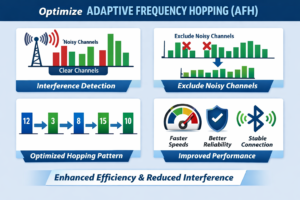
1. Optimize Adaptive Frequency Hopping (AFH)
Adaptive Frequency Hopping (AFH) is one of the most effective ways to reduce Bluetooth interference. It works by dynamically switching frequencies to avoid congested channels.
Why AFH Matters:
- Minimizes signal collisions
- Improves connection stability
- Enhances performance in dense environments
Optimization Tips:
- Enable AFH in your Bluetooth stack
- Keep firmware updated for better channel selection
- Monitor and blacklist noisy channels
AFH is your first layer of defense against wireless congestion.
2. Improve Device Placement for Better Signal Strength
Physical placement has a major impact on Bluetooth performance, especially in crowded IoT setups.
Best Practices:
- Avoid metal surfaces and reflective materials
- Maintain line-of-sight between devices
- Reduce clustering of transmitters
- Perform RF site surveys before deployment
Even small adjustments in placement can significantly reduce Bluetooth signal problems in IoT systems.
3. Adjust Transmission Power Strategically
Increasing transmission power may seem like a quick fix—but in dense environments, it often makes interference worse.
Key Considerations:
- High power increases signal overlap
- It raises network noise levels
- It drains battery faster
Recommended Approach:
- Use minimum effective transmission power
- Enable dynamic power scaling based on RSSI
- Calibrate settings for each environment
Smart power control improves both performance and efficiency.
4. Leverage Bluetooth Low Energy (BLE) Features
Bluetooth Low Energy (BLE) is optimized for IoT and includes several features to reduce interference.
Important BLE Features:
- Channel Map Updates
- Connection Interval Optimization
- Data Length Extension (DLE)
- PHY selection (1M, 2M, Coded)
Benefits:
- Reduced airtime
- Lower collision probability
- Improved battery efficiency
Using BLE correctly is critical for minimizing Bluetooth low energy interference.
5. Implement Time-Based Communication Scheduling
Simultaneous transmissions are a major cause of interference in IoT networks.
Solution:
Use time-based scheduling to coordinate device communication.
Techniques:
- Time Division Multiple Access (TDMA)
- Staggered transmission intervals
- Controlled broadcasting
Result:
- Fewer collisions
- Improved throughput
- Predictable network behavior
This is especially effective in industrial IoT environments.
6. Reduce Wi-Fi and Bluetooth Interference
Wi-Fi is one of the biggest contributors to Bluetooth interference since both operate on the same frequency band.
How to Fix It:
- Move Wi-Fi to 5 GHz band
- Use proper channel planning
- Keep Bluetooth devices away from routers
- Enable coexistence features in hardware
Managing Wi-Fi coexistence is essential for stable IoT connectivity.
7. Optimize Bluetooth Mesh Network Design
Bluetooth Mesh enables large-scale IoT deployments but can increase interference if poorly configured.
Common Issues:
- Message flooding
- Too many relay nodes
- High TTL values
Optimization Tips:
- Limit relay nodes
- Reduce unnecessary broadcasts
- Segment networks logically
- Fine-tune TTL settings
A well-designed mesh network improves scalability without increasing interference.
Final Thoughts
Bluetooth interference in IoT is not just a technical inconvenience; it’s a scalability challenge. As device density increases, so does the need for intelligent network design.
By applying these 7 strategies:
- Adaptive Frequency Hopping
- Smart device placement
- Transmission power control
- BLE optimization
- Time-based scheduling
- Wi-Fi coexistence management
- Efficient mesh design
You can significantly reduce interference and build IoT systems that are reliable, efficient, and future-ready.

